
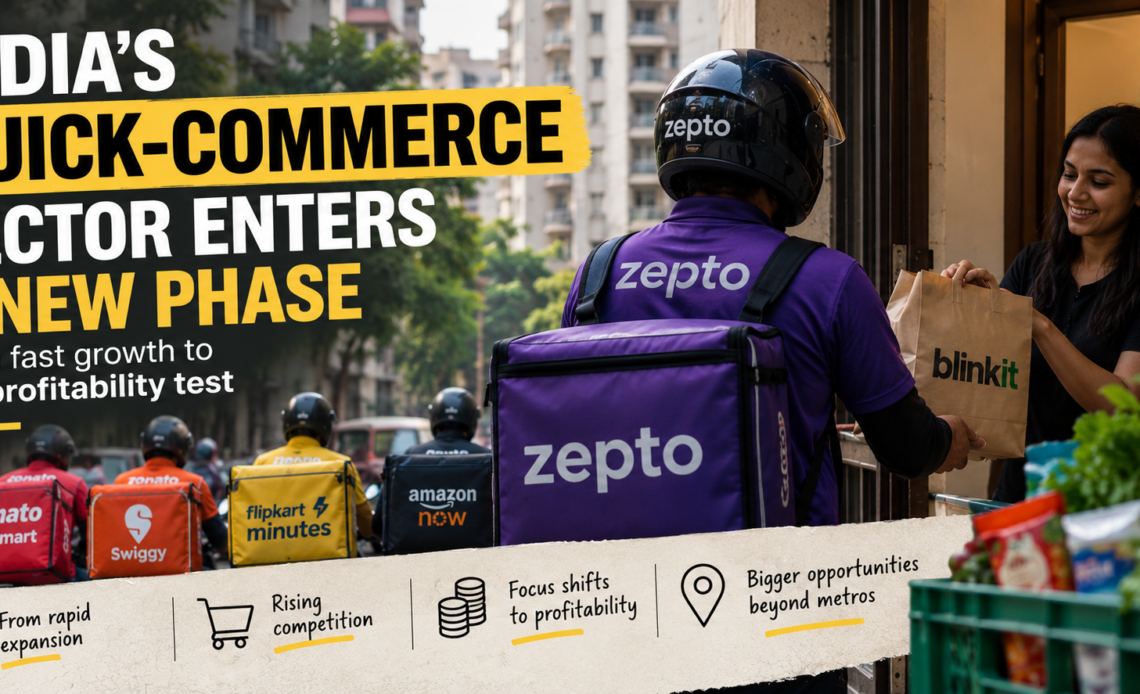
India’s quick-commerce industry is entering a new phase. After years of aggressive expansion, heavy discounts and rapid dark-store rollouts, the sector is increasingly being judged on a different metric: whether scale can translate into sustainable profits.
The market continues to attract significant capital, but the competitive landscape is changing. Blinkit, Zepto and Swiggy Instamart are now facing growing competition from established e-commerce companies such as Amazon and Flipkart, while BigBasket and JioMart are also adapting their strategies.
The result is a market where simply delivering faster or opening more stores may no longer be enough.
From 10-Minute Delivery to Profitable Growth
Quick commerce initially built its proposition around convenience—getting groceries and everyday products to consumers within minutes.
That model required companies to establish dense networks of dark stores close to customers while spending heavily on discounts, delivery and customer acquisition.
The focus is now shifting towards unit economics, store productivity and profitability.
As of Q1 FY27, Blinkit was the only major quick-commerce player reported to have reached EBITDA profitability. Its adjusted EBITDA margin stood at around 0.6%, with EBITDA of approximately ₹3 per order.
By comparison, Instamart was still reporting a loss of around ₹68 per order, while Zepto’s EBITDA loss was approximately ₹60 per order as of Q4 FY26. Instamart, however, has significantly improved its economics, with adjusted EBITDA per order improving by about ₹29 over the previous year.
The figures highlight a critical change in the industry: investors are increasingly looking beyond order volumes and gross merchandise value (GMV) to understand what each order actually contributes to the business.
Blinkit’s Profitability Provides a New Benchmark
Blinkit has emerged as an important benchmark for the sector because it has demonstrated that quick commerce can move towards profitability at scale.
The company reported revenue of approximately ₹38,000 crore in FY26 and has been focusing increasingly on improving the productivity of its existing dark-store network rather than relying only on expansion.
Industry experts cited by Business Today estimate that a typical dark store may require roughly 1,100–1,200 orders per day to reach break-even, although the number varies depending on location, store size, real-estate costs and other operating factors.
This makes density particularly important.
A dark store serving a large number of orders can spread fixed costs across more transactions. But a store with insufficient demand can quickly become a drag on the economics of the network.
Competition Is Getting Broader
The first phase of quick commerce was largely dominated by specialist platforms.
That is changing.
Amazon is expanding its quick-commerce offering through Amazon Now, while Flipkart has been scaling Minutes. Both companies bring established customer bases, technology platforms and extensive supply-chain infrastructure to the market.
Flipkart Minutes says it has reached 1,000 micro-fulfilment centres across more than 130 cities and 8,000-plus pincodes, with order volumes increasing fivefold over the previous year.
Amazon, meanwhile, is building a model that combines quick-commerce infrastructure with its much larger e-commerce assortment. The company has said it is expanding its network of dark stores and urban fulfilment centres, with an ambition to reach 300 cities and more than 3,000 stores over time.
This creates a new competitive equation.
New entrants may have access to large customer bases and substantial capital, but incumbent quick-commerce platforms have already established consumer habits and dense local networks.
The Market Opportunity Is Still Huge
Despite the increasing competition, India’s quick-commerce market remains far from saturated.
According to the Business Today report, Google and Deloitte expect India’s quick-commerce market to reach approximately $250 billion by 2030. The sector was estimated at around $50 billion as of April 2026.
Online grocery penetration also remains relatively low.
India’s online grocery market was estimated at around $12 billion in 2025 and is projected to reach approximately $103 billion by 2030, according to data cited in the report. Yet online grocery currently represents only around 1–2% of urban grocery consumption.
That leaves considerable room for digital platforms to expand.
The challenge is that a larger addressable market does not automatically translate into better economics. Companies still need to determine whether the model works profitably across different cities, consumer segments and store formats.
The Next Battle Is Beyond Groceries
Grocery remains the foundation of quick commerce because consumers purchase essentials frequently.
But grocery is also a relatively low-margin category.
That is pushing platforms towards products that can generate higher margins and larger baskets.
According to Redseer estimates cited by Business Today, grocery accounted for around 71% of quick-commerce GMV, while non-grocery categories contributed the remaining 29%. Beauty and personal care alone represented more than 8% of total quick-commerce GMV.
Categories such as beauty, personal care, electronics accessories, fashion, home products and other general merchandise could therefore become increasingly important.
The strategy is relatively straightforward: grocery can drive frequency, while higher-margin categories can improve profitability.
Private Labels Become More Important
Private labels are another part of this shift.
For quick-commerce platforms, owning or developing brands can provide greater control over pricing, margins and product differentiation.
Swiggy Instamart, for example, has been expanding its private-label portfolio, while Blinkit and Zepto have also developed their own brands. Other platforms are exploring similar strategies.
Private labels can also encourage repeat purchases.
If consumers begin visiting a platform specifically for a particular product or brand, the platform may have an opportunity to capture the rest of the customer’s basket as well.
For FMCG companies, however, the rise of private labels creates another competitive challenge. Platforms are simultaneously becoming distribution partners and potential competitors.
The Tier-II and Tier-III Opportunity
The next major growth opportunity could lie outside India’s largest metros.
A Deloitte-FICCI report cited by Business Today estimates that Tier-II and Tier-III cities already account for more than 60% of India’s e-commerce transactions. Deloitte expects Tier-II cities alone to account for approximately 30% of quick-commerce spending by 2030.
Platforms are already expanding into these markets.
Flipkart Minutes says its business in Tier-II and Tier-III cities grew 42 times over the previous year, alongside expansion into more than 90 additional cities.
But replicating the metro model outside major cities will not necessarily be straightforward.
A smaller city may support fewer dark stores and lower order density. Delivery expectations may also change, with 30-minute delivery potentially proving more practical than a 10-minute promise.
That could require a different operating model altogether.
Can India Sustain Multiple Quick-Commerce Players?
One of the industry’s biggest unanswered questions is how many platforms can achieve profitable scale.
Blinkit operates across 300 cities with more than 2,400 dark stores, according to the report. Instamart has around 1,181 dark stores across 128 cities, while Zepto operates around 1,225 dark stores across 61 cities. Flipkart Minutes is also rapidly expanding its network.
The opportunity is large enough to support further growth, but competition for the same customers can increase marketing costs and put pressure on margins.
Deep pockets can fund expansion, but capital alone does not guarantee customer loyalty.
Quick-commerce businesses must ultimately balance three things:
- Customer frequency
- Operational efficiency
- Profit per order
The ability to get these three variables working together could determine which platforms can sustain their expansion.
The New Metrics of Quick Commerce
The industry’s priorities have clearly changed.
Earlier, companies were celebrated for opening stores rapidly, increasing orders and gaining market share.
Today, investors are paying much closer attention to metrics such as:
Orders per dark store: How efficiently is each fulfilment centre being used?
Contribution per order: Does every additional order improve or weaken the company’s economics?
Customer retention: Are consumers returning without requiring heavy discounts?
Average order value: Can platforms increase the value of each basket?
Category mix: Are higher-margin products becoming a larger part of sales?
Private-label contribution: Can proprietary brands improve margins and customer loyalty?
These metrics provide a more detailed picture of whether a quick-commerce company can eventually become a sustainable business.
A Reset, Not the End of Growth
India’s quick-commerce sector is not necessarily slowing down. Instead, the definition of growth is changing.
The first phase was about creating consumer behaviour. Companies spent heavily to convince Indians that groceries and everyday products could be delivered within minutes.
The next phase is about making that behaviour economically sustainable.
The winners may not necessarily be the companies with the largest number of dark stores or the fastest delivery times. Instead, the market could increasingly reward businesses that can improve store productivity, increase basket sizes, develop higher-margin categories and convert customer frequency into sustainable cash generation.
India still has a large untapped online grocery opportunity, and quick commerce could play a major role in bringing more of that demand online.
But as competition intensifies, scale will increasingly need to come with discipline.
The quick-commerce race is therefore entering a new chapter—one where the question is no longer simply who can deliver fastest, but who can build a profitable business while doing it.
