


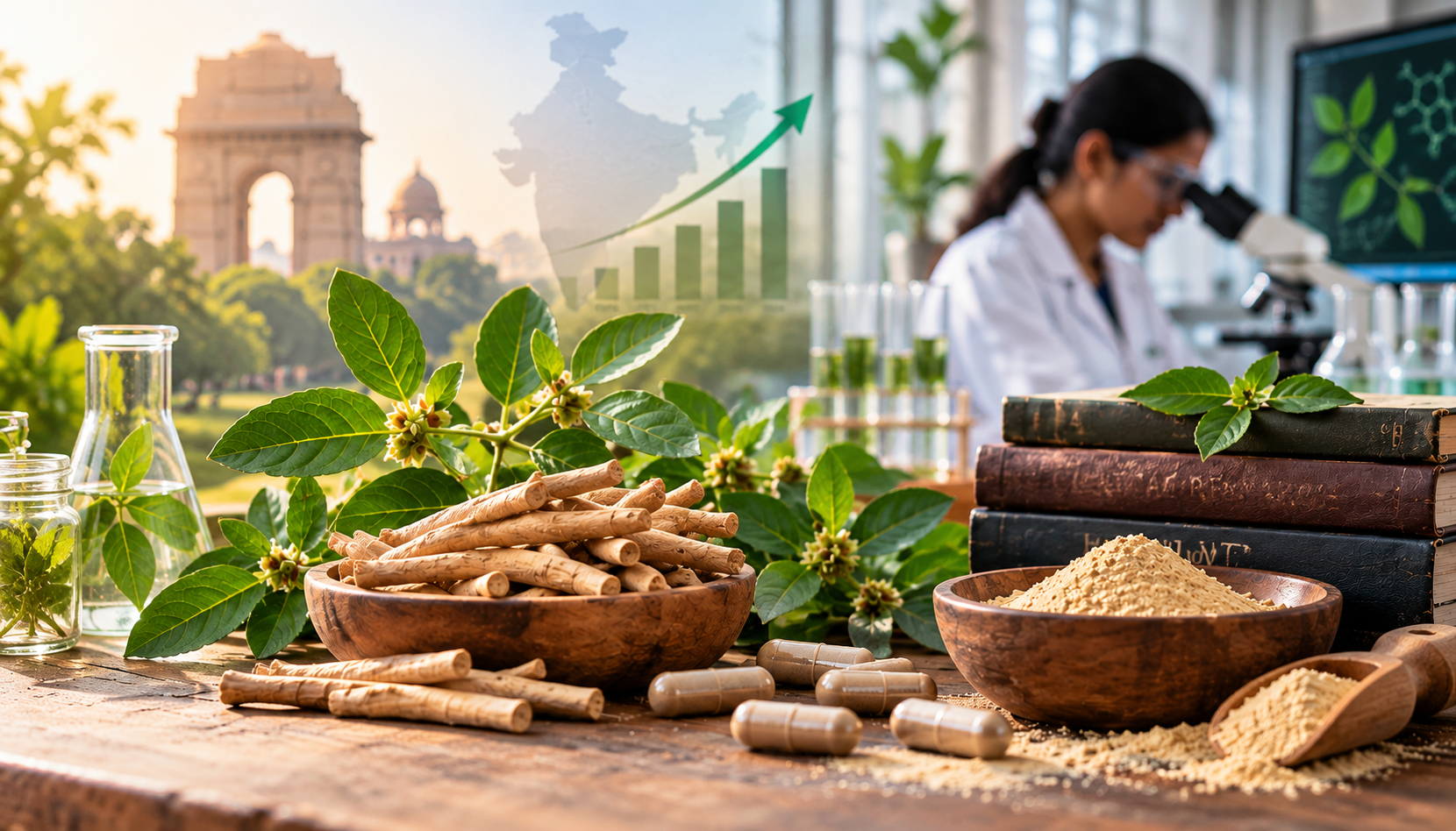
India’s Ashwagandha industry is gaining fresh momentum after a large government-backed clinical trial found that a standardised Ashwagandha root extract was well tolerated over 24 weeks, with no treatment-related liver or kidney injury reported.
The findings come as Ashwagandha moves beyond its traditional Ayurvedic use and becomes an increasingly popular ingredient in supplements, wellness products and herbal formulations in India and international markets.
The study involved 1,200 adults across seven centres in India and was conducted by researchers from nine institutions, including organisations under the Ministry of Ayush. It was published in Frontiers in Medicine on August 20, 2026.
24-Week Trial Examines Long-Term Safety
The randomised, double-blind, placebo-controlled study was designed to examine the safety and tolerability of prolonged use of a standardised Ashwagandha root extract.
Participants received either 500 mg of a standardised aqueous Ashwagandha root extract daily, equivalent to around 4 grams of raw root powder, or a placebo.
The participants were followed for 28 weeks, including 24 weeks of treatment. Of the 1,200 people who entered the trial, 1,032 participants, or 86%, completed the study.
Blood tests monitoring liver and kidney function remained within the reported reference ranges throughout the intervention period. Researchers found no evidence of treatment-related hepatic or renal injury.
No participant discontinued the study because of an adverse event, and no deaths were reported.
What the Study Actually Shows
The results provide useful safety evidence, but researchers have been careful about the scope of the findings.
The trial tested one specific standardised aqueous root extract at a particular dose among apparently healthy adults aged 18 to 70.
Therefore, the results should not be interpreted as proof that every Ashwagandha supplement or preparation available in the market has the same safety profile.
The study also did not establish that Ashwagandha is effective for conditions such as stress, anxiety or sleep problems. Additional controlled studies would be required to evaluate those potential benefits across specific populations and conditions.
This distinction could become increasingly important as the commercial Ashwagandha market expands and consumers encounter products with different formulations, concentrations and plant parts.
India’s Ashwagandha Market Is Expanding
The new clinical evidence comes at a time when demand for Ashwagandha-based products is growing.
According to estimates cited by Business Today, India’s Ashwagandha supplements market was worth approximately ₹657 crore ($68.4 million) in 2025.
The market is projected to reach around ₹1,421 crore ($148 million) by 2033.
Globally, the Ashwagandha market was estimated at approximately ₹7,296 crore ($760 million) in 2025 and is projected to reach around ₹11,328 crore ($1.18 billion) by 2030, according to Mordor Intelligence estimates cited in the report.
The growth reflects rising consumer interest in herbal and traditional wellness products, as well as the increasing global visibility of Ayurveda-derived ingredients.
Root Versus Leaf: An Important Distinction
The expanding market has also brought greater attention to the quality and standardisation of Ashwagandha products.
In April 2026, the Food Safety and Standards Authority of India (FSSAI) clarified that only Ashwagandha roots and their extracts are permitted for use in health supplements and nutraceutical products covered by its regulations.
The regulator also stated that Ashwagandha leaves and leaf extracts are not permitted in such food products.
The Ministry of Ayush similarly directed Ayurvedic drug and product manufacturers to use Ashwagandha roots rather than leaves and stressed that the plant part used should be clearly identified on product labels.
For manufacturers and consumers, the distinction highlights why the specific formulation and source of an Ashwagandha product matter.
The Trial Also Looked at Vaccine Response
The clinical trial was conducted against the backdrop of India’s Covid-19 vaccination programme.
Researchers also examined whether prolonged Ashwagandha use had any effect on the immune response generated after Covishield vaccination.
The study found no statistically significant difference in neutralising antibody levels between the Ashwagandha and placebo groups. Neutralising activity remained high in both groups.
This means the trial did not identify an additional immune benefit from Ashwagandha in this particular setting, nor did it find evidence that the extract interfered with the vaccine-induced immune response.
Adverse Events Were Monitored Closely
The trial recorded 337 adverse events among participants receiving Ashwagandha and 309 among those receiving placebo.
Most were described as mild to moderate and were primarily related to the digestive system.
Eight serious adverse events occurred during the study—six in the Ashwagandha group and two in the placebo group—but researchers did not consider any of them related to the study treatment.
The detailed monitoring is significant because safety and tolerability remain important considerations as herbal ingredients become increasingly commercialised and consumed over longer periods.
Scientific Validation Could Strengthen Ayurveda’s Global Position
The latest findings could contribute to a broader effort to generate clinical evidence around traditional Ayurvedic ingredients.
The study involved 45 researchers from nine institutions, including the Central Council for Research in Ayurvedic Sciences, All India Institute of Ayurveda, National Institute of Ayurveda, Jaipur, Ayush Centre of Excellence and Translational Health Science and Technology Institute.
For India’s herbal and wellness industry, research of this scale can potentially help create greater clarity around standardisation, safety and responsible product development.
The Ministry of Ayush has also emphasised the role of rigorous clinical research in strengthening the evidence base for Ayurveda.
What This Means for the Ashwagandha Industry
The commercial opportunity around Ashwagandha is expanding, but so is the need for stronger quality controls and evidence-based product development.
For manufacturers, this could mean greater emphasis on:
- Standardised extracts
- Clearly identified plant parts
- Quality testing
- Transparent labelling
- Clinically supported safety data
- Compliance with regulatory requirements
For consumers, the findings reinforce the importance of looking beyond the word “Ashwagandha” on a product label and understanding what specific extract, dosage and formulation a product contains.
A Growing Market With More Scientific Scrutiny
Ashwagandha’s journey from a traditional Ayurvedic herb to a globally marketed wellness ingredient is creating a new challenge for the industry: commercial growth must increasingly be supported by scientific evidence.
The latest 24-week clinical trial adds meaningful safety data for the particular standardised root extract studied, particularly regarding liver and kidney outcomes.
At the same time, the researchers’ findings do not establish that every Ashwagandha product is equally safe or that the herb is effective for every health condition.
As India’s Ashwagandha market continues to expand, the combination of traditional knowledge, scientific research, standardisation and regulatory oversight is likely to play an increasingly important role in determining how the industry develops in India and global markets.